


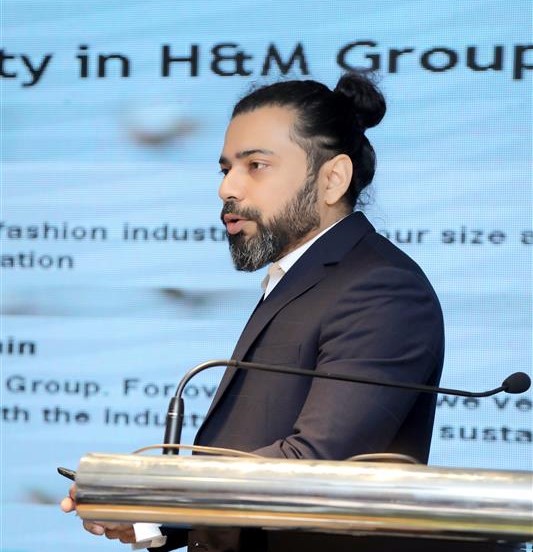
Mr. Faisal Rabbi, Former Stakeholder Engagement & Public Affairs Manager, H&M Group
H&M Group targets to reduce absolute greenhouse gas (GHG) emissions across their value chain by 56 per cent by 2030 and at least 90 per cent by 2040 (against a 2019 baseline). How does H&M Group plan to implement the agenda in Bangladesh?
Mr. Faisal: At H&M Group, our goal is to reduce absolute greenhouse gas (GHG) emissions across our value chain by 56 per cent by 2030 and by at least 90 per cent by 2040 (against a 2019 baseline). We will also balance out the remaining 10 per cent of unavoidable emissions to reach net-zero by 2040 through carbon dioxide removals. These goals were verified by the Science Based Targets Initiative (SBTI) in September 2022. We are focusing on several areas to reach these targets. Starting from minimising our energy use across our whole value chain, including our own operations and logistics activities, and throughout our supply chain.
We are also working to source 100 per cent renewable electricity in our own operations and engaging with partners and suppliers to push for their increased use of renewable electricity, heat, and steam. We are a RE100-member company. We stopped onboarding new suppliers with coal boilers in their facilities since January 2022. We are also developing new circular business models and reducing our dependency on virgin materials, which will be important steps to reduce our climate impact.
Our group goal applies to all production countries from which we source, and needless to mention, Bangladesh, being one of our most important sourcing markets, our focus remains on promoting energy efficiency and utilising renewable energy sources. We are also eager to explore the potential of renewable fuel sources to decrease our reliance on fossil fuels.
While we have been working with our suppliers to increase energy efficiency and installing solar panels on rooftops, we need to acknowledge that this will not be enough. Approximately half of the energy in our supply chain in Bangladesh is thermal energy (heat) generated in natural gas boilers. To decarbonise the readymade garment (RMG) sector, the industry needs to move towards electrification. This means that the national grid will need to be able to meet the industry’s needs in terms of capacity and continuity.
Giving access to renewable electricity generated outside factory premises (off-site) is crucial. Corporate Power Purchase Agreements (CPPA) allow direct trade between garment suppliers and renewable developers, and it is a direct mechanism to dramatically increase renewable energy generation and connect renewable electricity to export-focused sectors like the RMG. This will also have effects beyond our value chain. To us, it is clear that generating renewables will not be enough—we need to ensure connectivity through CPPA for textile factories, as claiming the attributes of the renewable electricity they are using is crucial.
The company has a goal to source 100 per cent renewable electricity to run its operations and supply chain by 2030. That is a medium to long-term plan. Does H&M Group have any year-wise targets and operative plan to execute them? What is the work plan of H&M Group to achieve this goal?
Mr. Faisal: In support of our overall climate goals, we aim to source 100 per cent renewable electricity in both our own operations and our supply chain by 2030. This requires a systemic change in the energy frameworks of our production countries. This is notable through advocacy for legislation supportive of Power Purchase Agreements and improved electricity grid connectivity in our production markets. Besides our advocacy for the CPPA framework in Bangladesh, together with Bestseller, we have announced plans to develop Bangladesh’s first utility-scale offshore wind project to increase the availability of renewable electricity in the country. We have translated our overall goal and ambition into our climate roadmap, which sets year-on-year internal targets for ourselves. We are currently working with our suppliers as well to develop their own climate roadmap, which will help them set up annual targets and plan to achieve them.
H&M Group aims to source all their electricity from renewable sources by 2030, while the textile industry in Bangladesh remains dependent on captive gas-based power plants. How does H&M Group plan to make this transition happen? Will it be a phase-by-phase approach? Have you already selected the factories that will stop using captive power and start renewables immediately?
Mr. Faisal: We have recently had promising conversations with Power Division and feel encouraged to work together with our suppliers to present a concrete proposal for the possible way forward. Together with USAID, we have assessed the current legislation in Bangladesh, and we believe that a Corporate PPA can be realised within existing legislation. We have submitted a draft Framework for Corporate PPA, and we are looking forward to the approval of this at the earliest possible time. Along with the CPPA framework, we also need a wheeling charge framework, an Environmental Attribute Accounting System, and a tariff mechanism to be established so that CPPA can become a business norm for the textile industry in Bangladesh.
In close collaboration with our valued business partners, as mentioned just a question ago, we have formulated a comprehensive roadmap outlining yearly targets to reduce GHG emissions. This roadmap outlines the steps we will take to improve our processes, utilise renewable energy sources both on and off-site, and adopt energy-efficient practices. These practices include the replacement of existing boilers with efficient, electric, or biomass boilers, as well as the implementation of disruptive technologies such as waterless dyeing. By working together towards achieving these targets, we aim to contribute towards the group’s net-zero target. However, we need to be careful here as electric boilers need more space and involve much higher investment costs. Without going into too many details, we need to reduce the need for thermal energy through process innovation, which is as mentioned just a moment ago, is by reducing water in our processes.