



Bangladesh can no longer depend on traditional economic growth, given the environmental adversities caused by these development patterns. Rather, a more balanced development where all three pillars, environmental, economic, and social, will be prioritised. Such a green and sustainable society can only meet the needs and desires of the voters of Bangladesh. Localised framework and policies for climate hotspots are now a core requirement for building a green and sustainable economy, as policy thinking among voters and political party candidates still mirrors national-level agendas while falling short on constituency-specific needs shaped by local climatic realities. The recommendations call for local policy frameworks and candidate manifestos that directly reflect hotspot priorities rather than relying on one-size-fits-all national commitments.
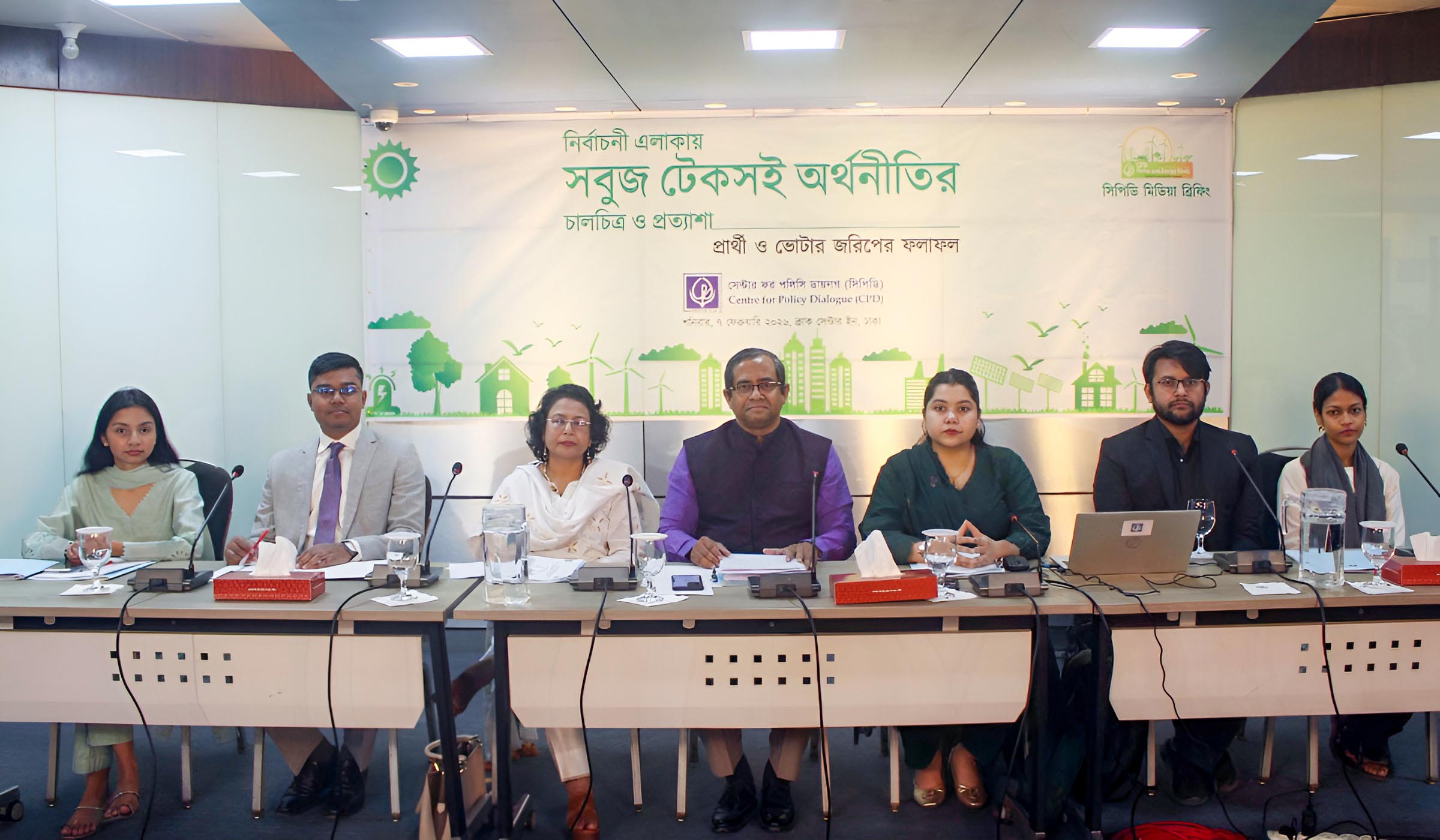
These observations emerged at the media briefing titled ‘State of and Expectations on ‘Green and Sustainable Economy’ in Electoral Constituencies: Survey Findings on Voters and Candidates’ held on Saturday, 7 February 2026, organised by the Centre for Policy Dialogue (CPD). The session was moderated by Dr Khondaker Golam Moazzem, Research Director, CPD. The keynote presentation was delivered by Ms Helen Mashiyat Preoty, Senior Research Associate, CPD, and Mr Sami Mohammad, Programme Associate, CPD.
Dr Shawkat Ara Begum, Bangladesh Programme Director at the Tara Climate Foundation, delivered the introductory remarks and emphasised the importance of green economic thinking ahead of elections.She warned about fossil fuel dependency, debt pressure and policy gaps in Bangladesh’s energy sector. She called for stronger focus on renewable energy, especially solar, and greater media engagement on green policies.
Dr Khondaker Golam Moazzem, emphasised, ‘Local governments need greater authority, resources and policy space to address environmental challenges effectively, while MPs should focus on national policy formulation and financing. Without stronger decentralisation, achieving a green economy across Bangladesh will remain difficult’.
A key proposal is to introduce a climate hotspot-specific framework that covers environmental, economic and social issues and fits local governance structures. This framework should redefine restoration beyond tree plantation and recycling and place renewable energy at the centre of restoration efforts.
The recommendations also push for changing how political commitments are made. National manifestos should operate as umbrella pledges, while union parishads should have localised manifestos focused on their own problems, with structured accountability for mayors, upazila leaders and MPs through regular coordination meetings.
On implementation, localised solutions require stronger local government authority and staffing. The proposals include amending the Local Government Act 2009 to devolve more power and budget to local authorities and establishing at least one environment office and one water department office at union level to enable local enforcement and delivery.
Environmental action is also framed as a two-phase approach. The first phase prioritises solving the immediate problems voters face, including air pollution, high temperature and rising health hazards, with measures such as removing brick kilns, relocating highly polluting factories away from residential areas and implementing zoning policies in industrial belts through local authorities.
The second phase focuses on renewable energy deployment and fossil fuel phase-out, including pushing rooftop solar for schools, colleges and clinics under national programmes, expanding distributed renewable projects locally and ensuring development allocations support decentralised clean energy rollout.
To make the transition politically and economically viable, the recommendations stress tying environmental protection to local economic welfare and social equity through employment-generating green initiatives, market-based solutions with people’s participation and targeted incentives to mainstream green practices.
Local government funding is described as too low to address environmental and social problems, calling for decentralised financing mechanisms, stronger annual allocations for city corporations and local authorities and a local revenue generation structure based on locally collected fees, fines and rents.
The recommendations further propose environmental grants for routine waste management, renewable energy adoption at community facilities, pollution mitigation and restoration initiatives, along with performance-based disbursement conditions such as basic reporting and community consultation to strengthen accountability.
Political follow-through is also addressed through proposals for a parliamentary environment caucus and sub-caucuses aligned to climatic hotspots, alongside building constituency-level data collection and analysis capacity through cross-agency cooperation so that local plans are evidence-based and implementable.
Social dimensions receive explicit attention in the recommendations, noting weak reflection of inclusivity and gender equality in green society commitments. Proposed measures include gender-targeted green jobs, improving women’s access to renewable energy finance and training and ensuring women’s participation in local environmental decision-making backed by gender indicators in green pledges.
In the open floor, journalists pressed a range of questions on election manifestos, the inclusiveness of the upcoming polls, economic stability, renewable energy policies and the role of local government in environmental governance.
They asked whether political party manifestos were realistic or merely symbolic, sought clarification on concerns about a less inclusive election environment, and questioned whether development pledges such as infrastructure projects fall more appropriately under local government rather than MPs. Journalists also raised issues about economic fragility, financing gaps in green commitments and public scepticism over whether campaign promises can be implemented.
Responding, CPD researchers said party manifestos show stronger commitment than before, but implementation depends heavily on financing and institutional capacity. They stressed the need for decentralised policymaking, stronger local governments, greater renewable energy awareness, continued economic reforms and improved accountability mechanisms to ensure green economy commitments translate into practical outcomes.
PRESS REPORTS
English (9)
- The Daily Star 1
- The Daily Star 2
- The Daily Star 3
- The Business Standard
- The Financial Express
- New Age
- Dhaka Tribune
- UNB
- Daily Asian Age
- Bangladesh Today
- Bangladesh Observer
- New Nation 1
- New Nation 2
- New Age


Bangla (18)
- Prothom Alo
- Inqilab
- Ittefaq
- Janakantha
- Jugantor
- Kaler Kantha
- Kaler Kantha
- Bonik Barta
- Protidiner Sangbad
- Protidiner Bangladesh 1
- Protidiner Bangladesh 2
- Manab Zamin 1
- Manab Zamin 2
- Ajker Patrika
- Amader Shomoy 1:
- Amader Shomoy 2:
- Bangladesh Protidin
- Daily Karatoa
- Desh Rupantor
- Sangbad 1
- Sangbad 2
- Alokito Bangladesh
- Amar Desh
- Bangladesh Protidin
- Bhorer Dak
- Bhorer Kagoj
- Jai Jai Din
- Kalbela


Online (69)
- Prothom Alo (English) 1
- Prothom Alo (English) 2
- Amar Barta
- Amar Sangbad
- Bahanno News
- Bangla Tribune
- Bangladesh Journal
- Bangladesh Times
- Bartabazar
- Bayanno
- BD Today
- BV News 24
- Channel i Online 1
- Channel i Online 2
- Citizens Voice BD
- Daily Prottoy
- Daily Sokaler Somoy
- Daily Jalalabad
- Dainik Sakalbela
- Deshkal BD
- Dhaka Journal
- Ekhon Tv
- Somoy News TV
- FNS 24
- Zoom Bangla
- ITV BD
- Jagonews 24
- Jamuna TV
- Just News BD
- Khabor
- Khulna Gazette
- Nagorik
- News g 24
- Rajneete
- Red Times
- RTV Online
- RTV Online
- Sara Bangla
- Sarakhon
- Shomoy News
- Simanta Bani
- Star News
- Sukhabor
- Sylhet Today 24
- Time News BD
- Times of Bangladesh
- U71 News
- Al-ihsan
- Times of Bangladesh (Bangla)
- Dhaka Stream
- Sharebazar News
- The People BD
- Natunjug
- Views Bangladesh
- Daily Provat Alo
- National Tribune 24
- Agamir Somoy
- Uttar Bhumi
- Daily Apandesh
- Nagorik Protidin
- Sangbad Porikrama
- Amar Barta
- Protifolon
- Deshkal News
- Nagorik Protidin
- France Dorpan
- Views Bangladesh
TV/Youtube Channel (14)