



Bangladesh’s renewable energy transition will not be secured by targets alone. It will depend on whether investors, lenders and power producers can trust that contracts will be honoured, payments will be made on time and risks will be shared fairly. Without credible payment security and bankable power purchase agreements, renewable energy projects may remain delayed, underfinanced or unattractive despite growing demand for cleaner and more reliable electricity.
These insights emerged at an event titled ‘Fourth Bangladesh-China Renewable Energy Forum’, organised by the Centre for Policy Dialogue (CPD) on Monday, 27 April 2026. The forum brought together policymakers, investors, financiers, renewable energy developers, business leaders and representatives from Bangladesh and China to discuss how Bangladesh can accelerate renewable energy investment, improve the contractual environment and deepen cooperation with Chinese investors and technology providers.
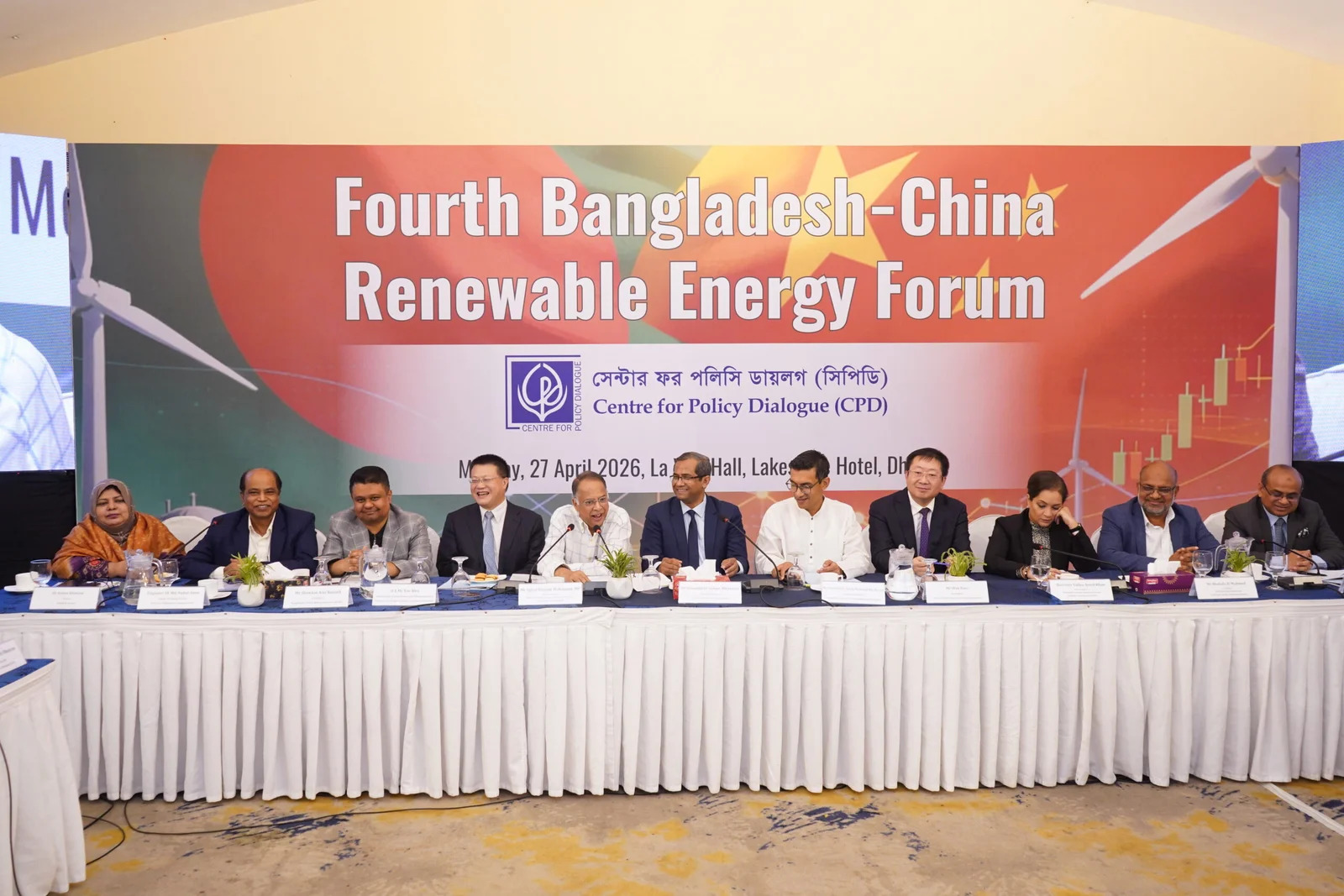
Speaking as the Chief Guest, Mr Iqbal Hassan Mahmood, MP, Hon’ble Minister, Ministry of Power, Energy and Mineral Resources, said the government was exploring ways to unlock unused public land for renewable energy projects, including land owned by ministries, railway authorities and other public bodies. He said the government wanted to create enabling conditions while allowing private investors to bring finance, technology and execution capacity. Referring to the government’s renewable energy ambition, he said, ‘Our target is ten thousand megawatts in five years.’ He added that solar power had become central to addressing the country’s energy challenge, stating, ‘Our only solution is solar power.’
From the perspective of Bangladesh-China cooperation, H E Mr Yao Wen, Ambassador Extraordinary and Plenipotentiary of the People’s Republic of China to Bangladesh, said Bangladesh’s present energy challenge should be treated as an opportunity to move towards a more resilient energy system. He emphasised that China was ready to support Bangladesh through policy coordination, technology transfer, industrial cooperation, local manufacturing and financing. ‘It is high time for Bangladesh to transition from relying on fossil energy to renewable energy, and it is also high time for China and Bangladesh to work together in this sector,’ he said. He added that Chinese enterprises could contribute to solar module production, energy storage and improvements in renewable energy project implementation.
The investment facilitation dimension was highlighted by Mr Chowdhury Ashik Mahmud Bin Harun, Executive Chairman, Bangladesh Investment Development Authority (BIDA), who said Bangladesh should learn directly from China’s renewable energy experience. He noted that BIDA’s planned first overseas office in China reflected the government’s interest in facilitating Chinese investment. He said public land could be used under public-private partnership models to speed up solar deployment, with private investors bringing capital and technology. ‘If we are trying to figure out what to do, we should ask them how they did it, and we could easily learn from them,’ he observed.
The keynote presentation was delivered by Dr Khondaker Golam Moazzem, Research Director, CPD, and Mr Abrar Ahammed Bhuiyan, Research Associate, CPD. They argued that Bangladesh must move from ‘Fallen Fossil Fuel’ to ‘Rising Resilient Renewables’ and identified the Power Purchase Agreement as a central instrument for translating investment confidence into real projects.
Dr Moazzem said Bangladesh should no longer view energy only from a crisis-management perspective, but should adopt a medium- to long-term transition strategy. ‘We have to realise that the fossil fuel chapter has to change,’ he said. Mr Bhuiyan said renewable energy investment remained constrained by weak PPAs, delayed payments, currency risks, lack of payment security, fragmented approvals and uncertainty over implementation agreements. ‘The PPA is not just a typical document; it is an instrument through which private capital either enters or avoids the power sector,’ he said.
Payment security and guarantees were strongly emphasised by Mr Han Kun, President, Chinese Enterprises Association in Bangladesh. He said renewable energy investment had become a major global trend and Bangladesh had a strategic window to attract Chinese capital. However, he warned that removing implementation agreements and payment guarantees had weakened project bankability. ‘The project bankability is severely undermined,’ he said, adding that payment risks of public offtakers need some form of government or credit-backed support if new investors are to enter the market. He also cited regional examples where guarantees or credit-enhancement tools have supported renewable energy investment.
Among the distinguished discussants, concerns centred on the practical barriers that continue to delay renewable energy projects. Mr Masudur Rahim, Chief Executive Officer, Omera Renewable Energy Limited, said rooftop solar could help Bangladesh achieve its renewable energy target more quickly because it faces fewer land constraints than ground-mounted projects. He urged the government to remove duties on rooftop solar equipment and address wheeling charges and grid-access issues under the merchant power plant model. ‘If government quickly removes the duties from rooftop solar equipment, then it can be implemented easily because there are no land issues,’ he said.
Land, approvals and investor confidence were also highlighted by Engineer SK Md Ruhul Amin, Deputy Managing Director, Chint Solar (Bangladesh) Company Limited. He said foreign investors had faced long approval processes, land-related uncertainty and project cancellations even after bringing funds into Bangladesh. Large solar independent power producer projects, he noted, could take four to five years if land and approval issues were not addressed. He urged the government to review cancelled projects and identify why recent tenders had failed to attract strong participation from credible investors.
The discussion then turned to the need for stronger coordination across public agencies. Dr Amina Khatoon, Partner, Doulah & Doulah, said renewable energy projects require coordination beyond the Ministry of Power, particularly with the Ministry of Land and the National Board of Revenue. She said delays often come from agencies that do not treat energy projects as urgent. ‘If we can include the Ministry of Land and NBR very closely, that will be very helpful,’ she said, adding that BIDA could play a stronger role in inter-ministerial coordination.
Industry representatives urged immediate fiscal and regulatory reforms. Mr Mostafa Al Mahmud, President, Bangladesh Sustainable and Renewable Energy Association (BSREA), said Bangladesh had no practical alternative to moving towards renewable energy. He called for action on solar panel valuation, battery taxes, access to finance, electric vehicles, solar irrigation, merchant power rules and faster services from SREDA. ‘We have to go for the transition; there is no other alternative,’ he said.
For export-oriented industries, renewable energy has become a competitiveness issue as well as an energy issue. Barrister Vidiya Amrit Khan, Vice President, Bangladesh Garment Manufacturers and Exporters Association (BGMEA), said the readymade garment and textile sectors were under growing pressure from buyers and export markets to demonstrate green energy sourcing. She called for a clear and simple pathway for the private sector, favourable wheeling charges, reduced financing costs and targeted tax relief for quality batteries rather than blanket exemptions. ‘What we want is a very clear and simple pathway,’ she said, adding that brands should also share responsibility for financing the transition.
The open floor discussion reinforced the need for practical reforms. Participants raised concerns over guarantee approval procedures, foreign exchange-related guarantee fees, the cancellation of renewable energy projects, rooftop solar financing, diesel-based irrigation, industrial power shortages, hydropower imports, grid readiness and the role of households and small businesses in producing their own electricity. Several speakers urged the government to restore investor confidence quickly, simplify approvals and treat renewable energy as an urgent national priority.
The forum concluded with a broad consensus that Bangladesh’s renewable energy transition will depend on moving from policy ambition to bankable implementation, with payment security, coordinated approvals, land access, fiscal incentives and Bangladesh-China cooperation at the centre of the next phase.