



In a recent interview with Ms Helen Mashiyat Preoty, Senior Research Associate, CPD, official from the Bangladesh Power Development Board (BPDB) shared updates on the progress, design, and implementation of the National Solar Rooftop Programme announced by the interim government. The discussion explored how the programme is being operationalised across government offices, educational institutions, and health facilities, the rationale behind the CAPEX and OPEX implementation models, tariff considerations, financing mechanisms, and the institutional coordination required to overcome early challenges. The interview also reflected on the causes of initial delays, recent progress across districts and utilities, and how the rooftop solar initiative fits into Bangladesh’s broader pathway to achieving its renewable energy targets by 2030 and beyond.
The interim government had announced to generate 3000 MW of solar power from the National Solar Rooftop Programme. What is the current status of the programme? In the last 6 months, how many government offices, schools, and clinics have initiated the programme?
BPDB: The National Solar Rooftop Programme is monitored and overseen by the Ministry of Power, Energy, and Mineral Resources. There are several related stakeholders in this programme, and each is working to ensure its success. Significant progress has been made under both initiative A and initiative B. As a pilot project, the BPDB has initiated the establishment of at least one rooftop solar plant with a capacity of 15 kW in all districts of Bangladesh. Visible progress (either under implementation or implemented) has been made in 18 districts. Under initiative B, a total of 224 tenders, totaling 1282.91 MW of solar power, have been invited from BPDB, REB, DPDC, DESCO, NESCO, and WZPDCL.
After the initial circular was published, there were several concerns raised regarding the calculation of sanction load, financing model, maintenance, and others. How have these concerns and suggestions been incorporated?
BPDB: Through our continuous meetings and consultations, we have tried to address the comments and feedback of the stakeholders. For example, the limit for sanction load for educational and health institutions has been relaxed. Now they can generate electricity at their full capacity. Another concern raised by some stakeholders is the need to upgrade transmission lines from single-phase to three-phase. It has been decided that the BREB will do the necessary to ensure the line upgrade with its own finances.
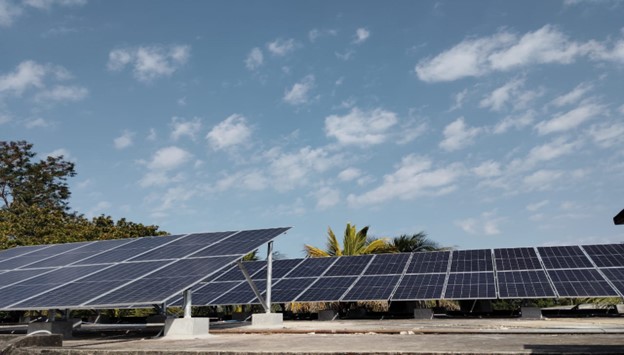
Kaptai Training Academy Rooftop Solar Panels. Photo: Courtesy.
For the government buildings, only one model – the CAPEX model – has been suggested. However, for educational and health establishments, four different OPEX model formats have been suggested. Would you like to brief on the appropriateness of these models?
BPDB: Under the CAPEX model, the government offices are installing rooftop solar with their own investment. As offices and authorities finance rooftop solar with their own investments and utilise their own manpower, it is beneficial and cost-effective for government offices to adopt the CAPEX model. Under the CAPEX model, the rooftop solar systems will reach breakeven points within 5 years of investment. However, in the case of educational and health institutes, the CAPEX model will not work as the schools, colleges, clinics, and hospitals do not have their funds to invest in. There are also other issues, such as maintenance and follow-up of the rooftop solar. This is why the OPEX model with a long 20-year contract with a third party is a more appropriate model for the educational and health institutes.
How will the tariff be determined in both (CAPEX and OPEX) model cases? Will BERC play the role of a regulator in tariff determination and maintenance?
BPDB: There is a technical and mathematical model used for tariff determination in both the CAPEX/OPEX models. Under the CAPEX model, the average tariff rate is BDT 4.5-5 per unit. As the third party will be awarded through open tender under the OPEX model, the EPC or utility with the lowest proposed tariff will naturally win. But tariffs are higher and vary depending on the location, structure, model, and contractor. But it will be lower than the bulk tariff.
What are the challenges faced by the different government organisations (rented building/ owned), educational institutions, and clinics in the planning process, execution, and implementation process?
BPDB: We have not faced any particular challenge in the case of government buildings while implementing the programme. However, there was some resistance from educational institutions at the beginning. Since the educational and health institutes were unaware of the collaboration, they were hesitant. Later, when the MoUs were signed between the Ministry of Power, Energy, and Mineral Resources and the Education and Health Ministries, they were supported and encouraged. From all the ministries, a focal point has been selected and assigned the responsibility to coordinate.
There is a delay observed in the implementation progress; by 2025, a significant amount of solar electricity was supposed to be added to the grid. But that did not happen. In your opinion, what caused the delay, and how is BPDB planning to catch up with the delay?
BPDB: Under the CAPEX model, the government offices are installing rooftop solar with their own investment. As offices and authorities finance rooftop solar with their own investments and utilise their own manpower, it is beneficial and cost-effective for government offices to adopt the CAPEX model. Under the CAPEX model, the rooftop solar systems will reach breakeven points within 5 years of investment. However, in the case of educational and health institutes, the CAPEX model will not work as the schools, colleges, clinics, and hospitals do not have their funds to invest in. There are BPDB: The National Rooftop Solar Programme is a new initiative for Bangladesh, and we wanted it to be comprehensive and accurate. To do so, we sought to address the concerns of all stakeholders. The entire process took longer than we initially anticipated.
In the rooftop solar energy sector, financing facilities are available through two mechanisms: financing by financial institutions and a refinancing facility by the Bangladesh Bank. But it is obvious that the financing schemes will be preferred over refinancing once. Which financing scheme do you think is ideal for this programme?
BPDB: Under OPEX model, we are encouraging investors to go for refinancing schemes as the interest rate is lower in that. The interest rate under the refinancing scheme is below 5 per cent, making it more attractive to EPCs and investors.
Is there any further plan to expand the areas of the National Rooftop Solar Programme?
BPDB: Yes, we have plans to further expand the programme for the private sector. We will target different industries and businesses to establish rooftop solar under this programme after the successful completion of the current phase.
What is the plan of MoPEMR to achieve the 20 per cent RE by 2030, along with the National Rooftop Solar Programme and the Merchant Power Policy?
BPDB: We are extensively working towards achieving the renewable energy goals. The procurement process is currently underway for 50 power plants with a capacity of over 5,000 MW. BPDB plans to add another 1,060 MW of renewable energy. EGCB, Northwest, and other utilities are also working on adding more renewable electricity to the grid by 2040.