




Mr Fazlee Shamim Ehsan, Executive President, BKMEA
What is the objective of BKMEA to move towards the energy transition in Bangladesh? And how does BKMEA plan to do so?
Mr Ehsan: The sole objective of the BKMEA is to help the government increase the share of renewable energy in the national energy mix through increasing the renewable energy use in the factories of BKMEA members and the RMG sector as a whole. We try to do so by advocating at the policy level to make funding easily accessible for businessmen and making the businessmen aware of the need for green transition in the RMG sector.
Does BKMEA have any medium to long-term plans regarding the renewable energy expansion? Is there any operative plan to execute the target? What is the work plan of BKMEA to achieve this goal?
Mr Ehsan: The BKMEA aims to ensure greening the factories by 2029 and add that to the electricity into the grid through a net metering system. For the Just Transition and Environmental Sustainability in Bangladesh’s RMG Industry, BKMEA has launched the Green Industry Development Cell (GID Cell) for the first time in the corporate sector. A just transition ensures that workers and communities are not left behind during this transformative process. The BKMEA has always been trying its best to achieve the SDGs by 2030. Whereas the Bangladesh government looks forward to greening its energy and manufacturing to sustain its economic growth and climate change.
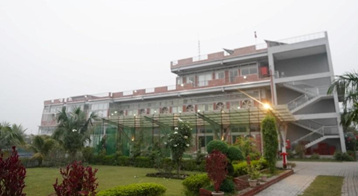 Fatullah Apparels Limited
What are the limitations that were faced in order to set up the solar PV infrastructure in the RMG industries?
Mr Ehsan: The first and foremost challenge is access to funding. There are so many scopes of funding currently available by banks, financial institutions, and international development partners, such as (JICA, World Bank). However, the issue is that these funds mostly require unreasonable and unrealistic conditions to be met by the factories to avail the loans or grants. Such as, it has to be a limited company for 10 years and so on.
Bangladesh Bank also offers refinancing schemes for sustainable financing. As a result, mostly the entrepreneur needs to install solar PVs on their own, which is comfortable for the large factories, but a huge challenge for the small and medium ones. The second challenge is the discriminatory fiscal and financial structures of renewable energy and fossil fuels. The government is still paying subsidies for fossil fuels, along with tax and import duty waivers.
However, renewable energy is neither subsidised nor exempted from tax and import duty. It does not motivate businesses to go for renewable and sustainable energy. Lastly, the operational process of setting up PVs in the factories is lengthy and time-consuming, which is a major constraint for businesses.
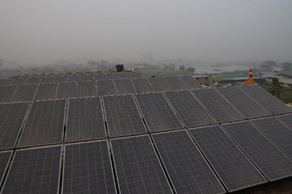 Rooftop solar of Fatullah Apparels Limited
From the industrial electricity demand perspective to what percentage share of renewable energy can meet? Not only from solar PVs but also from the grid, cost-wise wise is it possible to fully meet the factory operation from renewable energy?
Mr Ehsan: From the BKMEA, we are not considering renewable energy as the only source of energy. Instead, we consider renewables as a backup or secondary source, as grid electricity will be the key power source. In mathematical terms, for a two-storied factory building, 60 per cent of the electricity could be generated from rooftop solar panels installed on that building. The electricity can be added to the grid through a net metering system. However, if we promote energy efficiency throughout the production system, nearly 92 per cent of the electricity can be saved.
Do you think that other major businesses may consider renewable energy as a suitable option for the energy source and initiate similar energy transition goals?
Mr Ehsan: Energy transition could mean different things for each industry. A leather factory, for instance, can easily meet its electricity demand from renewable energy sources installed within the factory; along with energy efficiency, it will be easy to move towards energy transition. However, a steel factory—with a power demand equivalent to almost 200 RMG factories—needs to focus on energy efficiency for greening rather than sourcing from renewables.