



Originally posted in The Daily Star on 12 March 2026
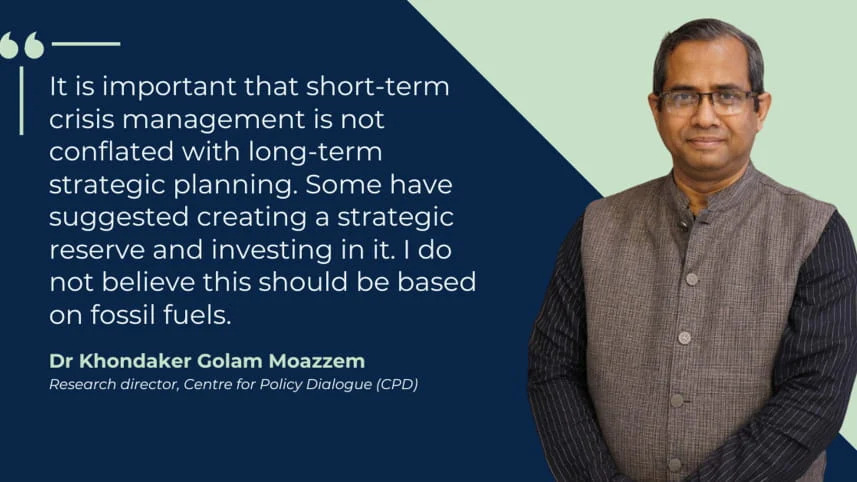
Dr Khondaker Golam Moazzem, research director at the Centre for Policy Dialogue (CPD), speaks with Naznin Tithi of The Daily Star about how the government should respond to the ongoing global energy crisis affecting Bangladesh, its rationing plans, and what additional steps it can take to address the situation.
The energy crisis caused by the US-Israel war against Iran has already hit Bangladesh. We have witnessed a spike in panic buying. Some have called for priority‑based distribution among industries. The government, meanwhile, has assured that it holds sufficient fuel reserves but rationing still continues. How do you view this situation?
The global energy supply chain is facing disruptions due to the crisis in the Strait of Hormuz, resulting in a significant level of supply uncertainty. In this situation, even paying higher prices does not necessarily guarantee access to fuel, prompting countries to seek alternative sources of energy imports. Being an import-dependent country, Bangladesh has introduced rationing measures to extend the use of its current stock of fuels. This is a crisis management strategy. There is indeed a supply shortage in the market; the usual level of fuel supply cannot be ensured at present. The aim is to ensure that all sectors receive at least some fuel, even if in smaller quantities.
Energy is a fundamental input in nearly all forms of economic activity. When supply is restricted, it inevitably has a negative impact across sectors. Right now, this is the reality we face. We should not expect normal conditions during this period. The government is working to distribute the limited supply across sectors, prioritising certain areas where necessary and making adjustments to manage the situation as effectively as possible.
Do you think the government is adequately addressing the situation, i.e. with rationing and price control?
The course of the war is shifting almost daily, making it uncertain as to how long the conflict will continue. In my view, prolonging the war offers little gain for either side. Just as Iran is unlikely to achieve significant benefits by extending the war, so are the United States and Israel. Nevertheless, the government must plan its strategies according to the scale of the crisis. Initially, it introduced rationing but simultaneously sought to secure energy from alternative sources. For example, two contracts were finalised for LNG import at more than double the usual prices, which was a logical and necessary decision under the circumstances. At this stage, spot purchases to manage the crisis are reasonable, even if they come at a higher cost. Likewise, refined petroleum can be sourced from neighbouring or Southeast Asian countries, and China has also offered cooperation. These initiatives demonstrate proactive government action, and in my assessment, the efforts have so far been positive.
It is important, however, that short-term crisis management is not conflated with long-term strategic planning. Some have suggested creating a strategic reserve and investing in it. I do not believe this should be based on fossil fuels.
If domestic gas exploration in the Bay of Bengal—which previous governments neglected—had been pursued, the country would be in a stronger position to manage this situation. For example, rather than relying on diesel-powered irrigation for the upcoming Boro cultivation, it would have been better to expand renewable energy-based or solar-powered irrigation. Currently, we have around 13 lakh irrigation pumps, of which only about 13,000 are equipped with solar panels. Expanding this number could have significantly reduced diesel demand. Similarly, a gradual transition to battery-operated vehicles would increase electricity demand but reduce the need for diesel and petrol.
Strategically, long-term objectives must not be sacrificed for short-term demands. This is crucial. The government should continue following a rolling plan—monitoring daily developments, assessing changes, and adjusting initiatives accordingly. In my view, the government’s rolling plan has so far been largely on track. Unfortunately, people tend to be highly susceptible to rumours and have limited trust in official data. This increases the tendency towards hoarding. The reality, however, is that operations must continue with limited supply, and normal economic activity cannot be fully maintained. This is a reality that all consumers must understand.
Given the concerns surrounding rationing and priority-based distribution, who do you think should be prioritised?
Determining who should be given priority is a highly sensitive issue, particularly when it comes to fuel supply. However, it is clear that industries should be included on the priority list. This is because they are connected with production, employment, exports, foreign currency earnings, and the balance of payments. So industries, especially the export-oriented one, must be a priority. In addition to small- and medium-sized industries, a large number of motorbike riders depend on fuel for their livelihoods, who should also be considered carefully. Public transport should be given higher priority, while large vehicles—whether government-owned or privately operated—should be given lower priority. Priority should go to those engaged in production-related work in factories, whose income relies on fuel and whose livelihoods are closely tied to fuel-dependent activities.
It is somewhat reassuring for the government that diesel demand remains low at present, as Boro irrigation has not begun yet. However, in the next month or so, diesel demand is likely to increase when irrigation will be required for Boro cultivation. Hopefully, the war will not continue till then.
The government has introduced some austerity measures such as the closure of universities, requesting shopping malls to reduce the use of lighting, and so on. Could it have done more? Government officials are still using vehicles without restraint, a practice the authorities could have restricted.
In our country, apart from announcing austerity measures and relying on people’s personal sense of responsibility, little else is done. By contrast, in many developed countries, we observe that drivers switch off their engines while waiting at traffic signals, reducing both pollution and fuel consumption. Unfortunately, that culture does not exist here. As a result, energy is often used neither cost-effectively nor efficiently. Electricity consumption is similarly inefficient. If we had a modern fuel supply and electricity infrastructure, distributors and suppliers could exercise far greater control. But that infrastructure does not exist here. Consequently, energy usage depends almost entirely on individual discretion—on how much a person chooses to use or conserve.
At a minimum, the government can ensure that the measures it has already announced—such as reducing diesel consumption, limiting fuel use in government offices, and curbing lighting—are properly implemented. By reporting regularly on these measures and informing the public about the actions taken against those who fail to comply, it can raise awareness and encourage more responsible energy use.
There are concerns that inflation could rise further as a result of the war. We already saw inflation exceeding nine percent in February, the highest in 10 months. In this situation, what should the government do?
The entire situation is beyond our control. Ordinary people are bearing the brunt of other countries’ strategic wars and territorial conflicts, which is unacceptable. The government can provide support to the people by increasing supply through social safety net programmes. Truck sales are already taking place, the Family Card programme has been launched, and a reasonable social support system is already in place. Expanding the reach of these programmes even slightly would be beneficial. The government is reportedly planning to continue truck sales until March 12. If it is extended for another week, until March 19, and supply is increased in more locations, low-income households could experience some relief.
Price increases are already becoming a reality at the import stage. In such cases, monitoring is needed at the import and distributor or dealer levels, rather than only at the retail level, to protect consumer rights. It is also necessary to monitor whether goods are being hoarded or supplied in quantities below the usual levels in the market.